Do you know the best CMS solutions for websites?
Loading last updated info...
You don’t want to build solutions from scratch, so take what business value you can from a CMS: don't reinvent the wheel.
A CMS allows business users to build and manage websites without having to write any code.
Top CMS vendors (including eCommerce and websites)
These CMS platforms work really nicely for simple scenarios. If they fit your business case then use them.
Source: WordPress Market Share Statistics (2011-2024)
Top CMS vendors for enterprise websites (.NET based)
When you have a complex business case, you need something more customizable. That's where enterprise CMSs come into play.
- DotNetNuke - (open source / pricing non-transparent)
- Sitefinity - ($$ approx $40k per year)
- SiteCore - ($$ approx $50k per year)
- Umbraco - (open source / pricing non-transparent)
- Kentico Xperience - (formerly Kentico EMS / $$ approx $20k per year)
Source: Top 5 .NET Based CMS Platforms For Your Business (Updated 2023)
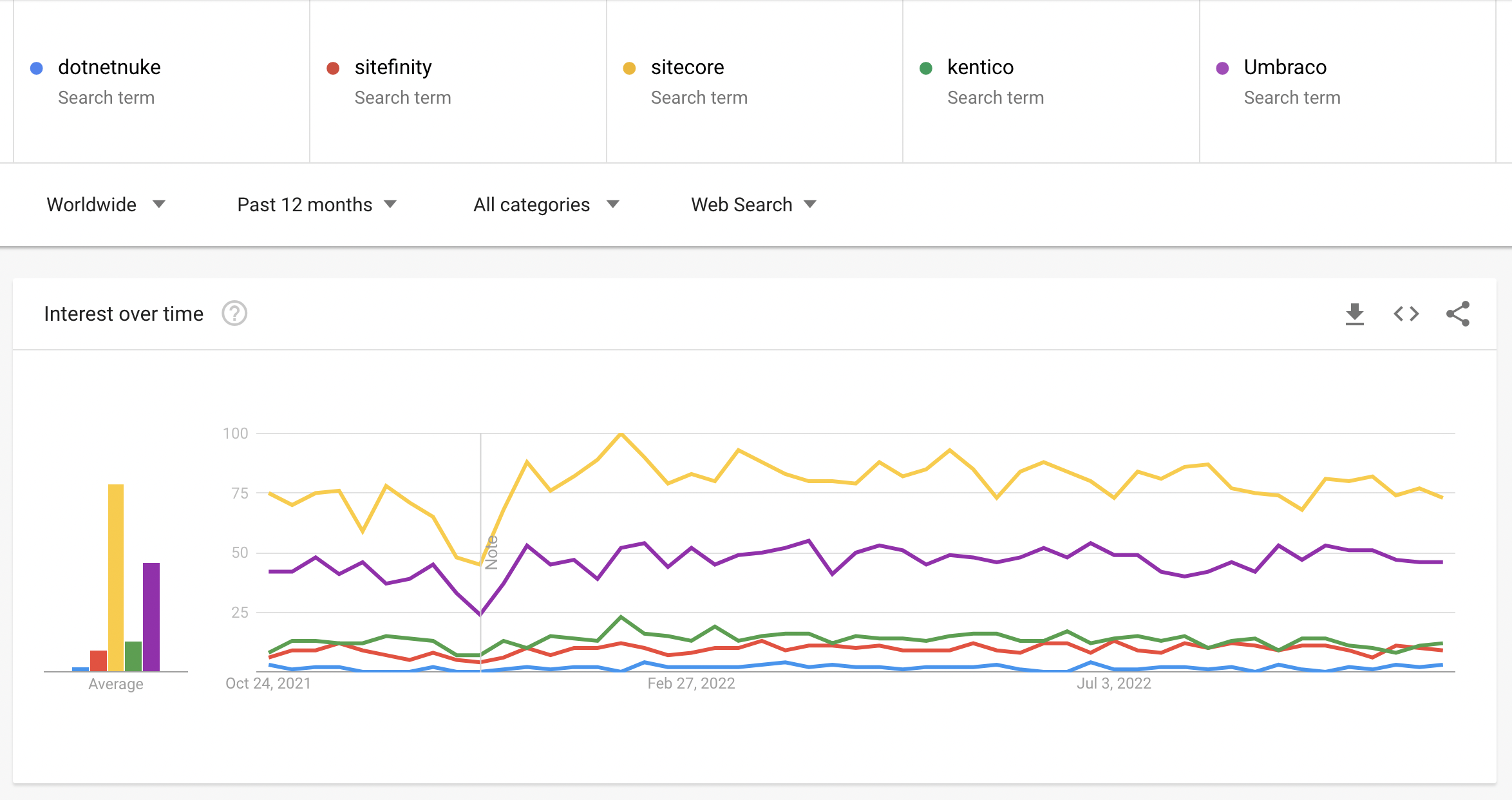
Figure: Google trends of the above .NET CMSs. The leading (but most expensive) is SiteCore, and in second is Umbraco (which is much cheaper)
View current trend information for these products.
Top headless CMS
- WordPress VIP - (pricing non-transparent)
- Sanity.io - (pricing non-transparent)
- Magnolia - (pricing non-transparent)
- Contentful - (pricing non-transparent)
- Arc XP - (pricing non-transparent)
Source: 16 Best Headless CMS For Publishers in 2023
Other headless CMS (.NET based)
- Squidex (open source / free / $ enterprise plan)
- SiteServer (open source / free)
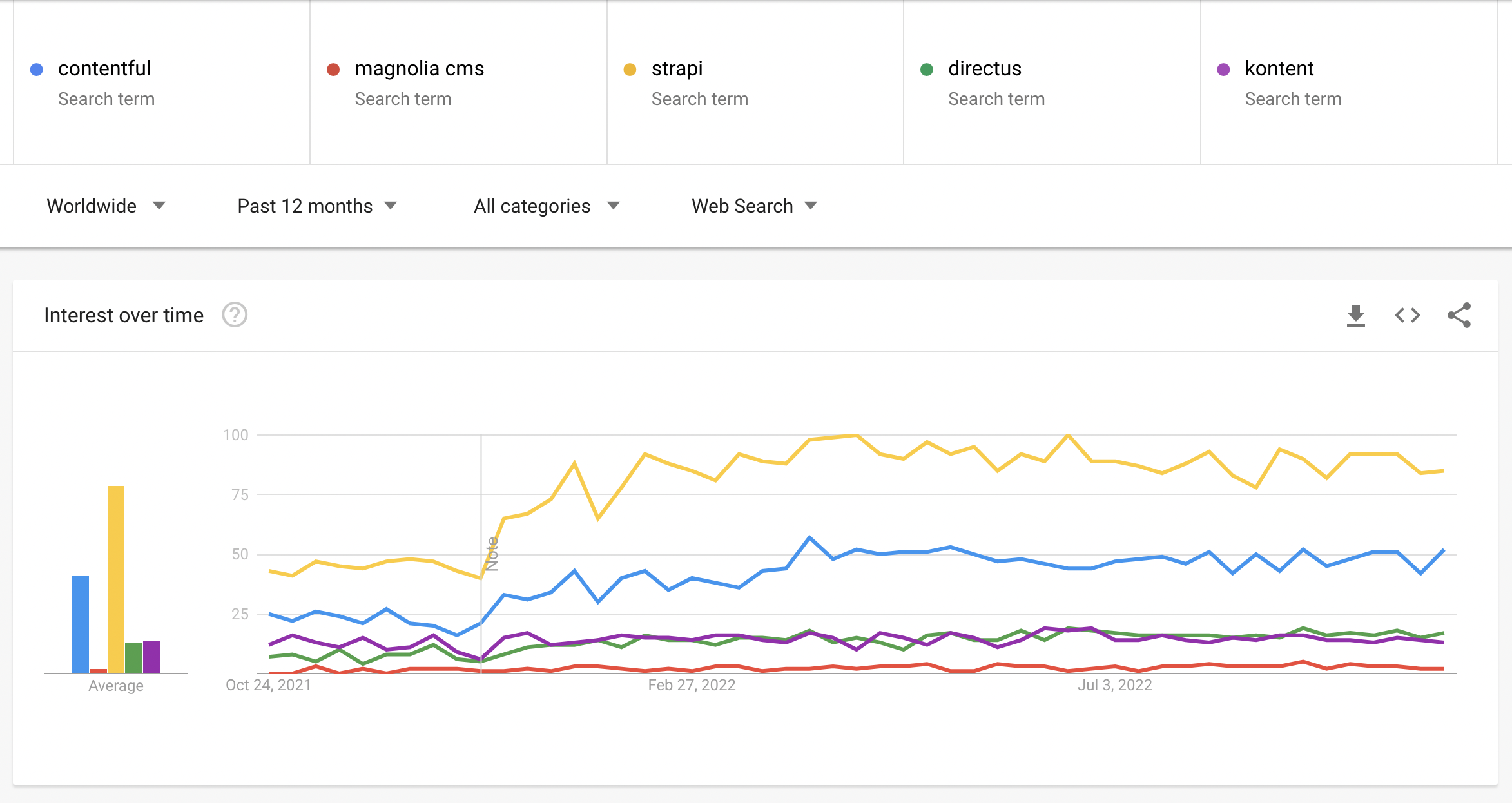
Figure: Google trends of the above Headless CMSs. The leading is the open-source Strapi, which is inexpensive, but not as feature rich as Contentful (second) and Kontent (third)
View current trend information for these products.
Headless CMS vs Traditional CMS
A Traditional CMS is a monolith, which means it has both a front-end and back-end. It uses server side technology like PHP (Wordpress, Joomla, Magento) or ASP.Net (DNN, Umbraco, Sitefinity) and a single database. All pages are served by one or many backend servers.
A Headless CMS deals strictly with the content. Created content is accessed via Application Programming Interfaces (APIs), which gives you full flexibility on how you build the front-end for your website. Headless CMSs are also very appropriate for JAMstack sites: see the State of Jamstack 2021 Report by Kentico for more information.
For example, you can use a Headless CMS with a super fast Static Site Generator (SSG): see the rule on the best static site tech.
Source: UDig - Traditional CMS vs Headless CMS
Traditional CMSs like Sitecore and Kentico Xperience have their place, especially if you have no developers and you’re comfortable with serious vendor lock-in. Headless CMSs and static sites for the win. -Adam Cogan
Here is a breakdown of Traditional CMS architecture vs Headless CMS architecture:
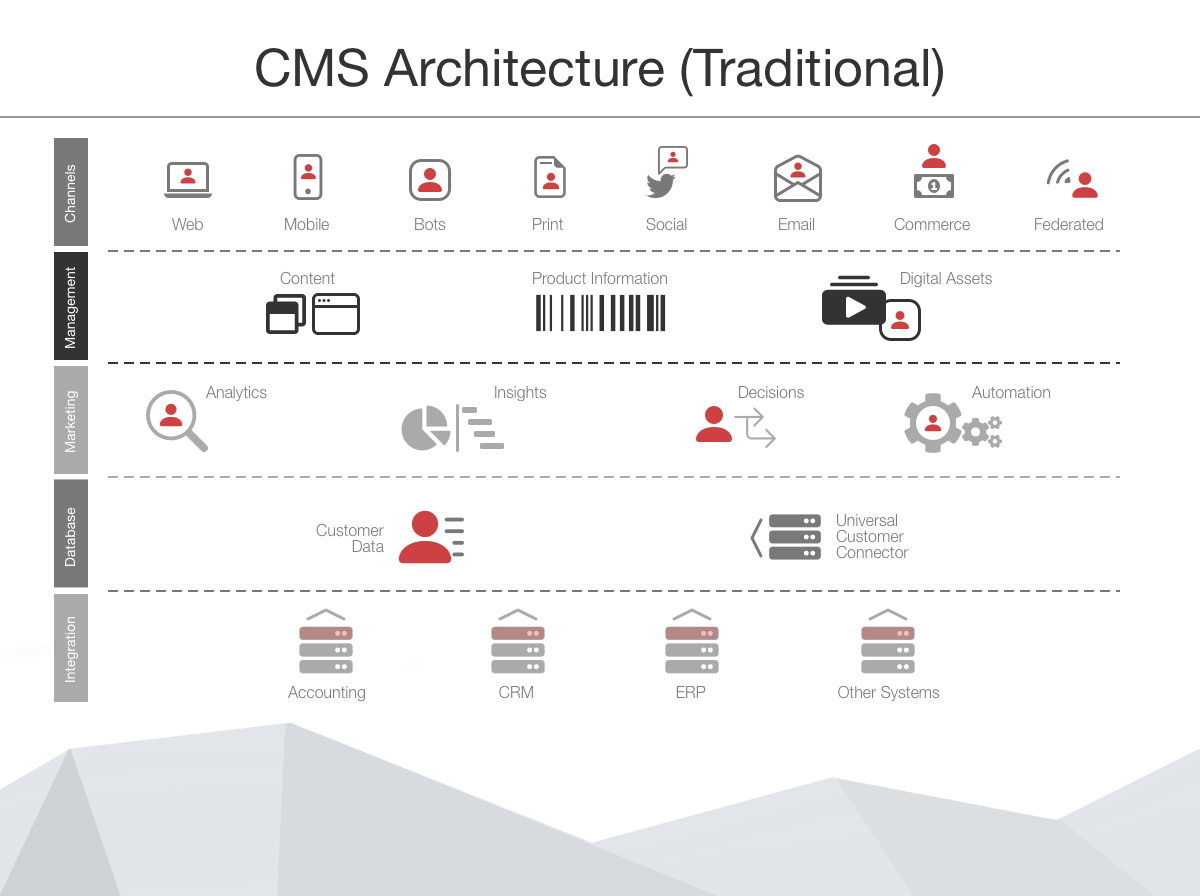
Figure: Traditional CMS Architecture
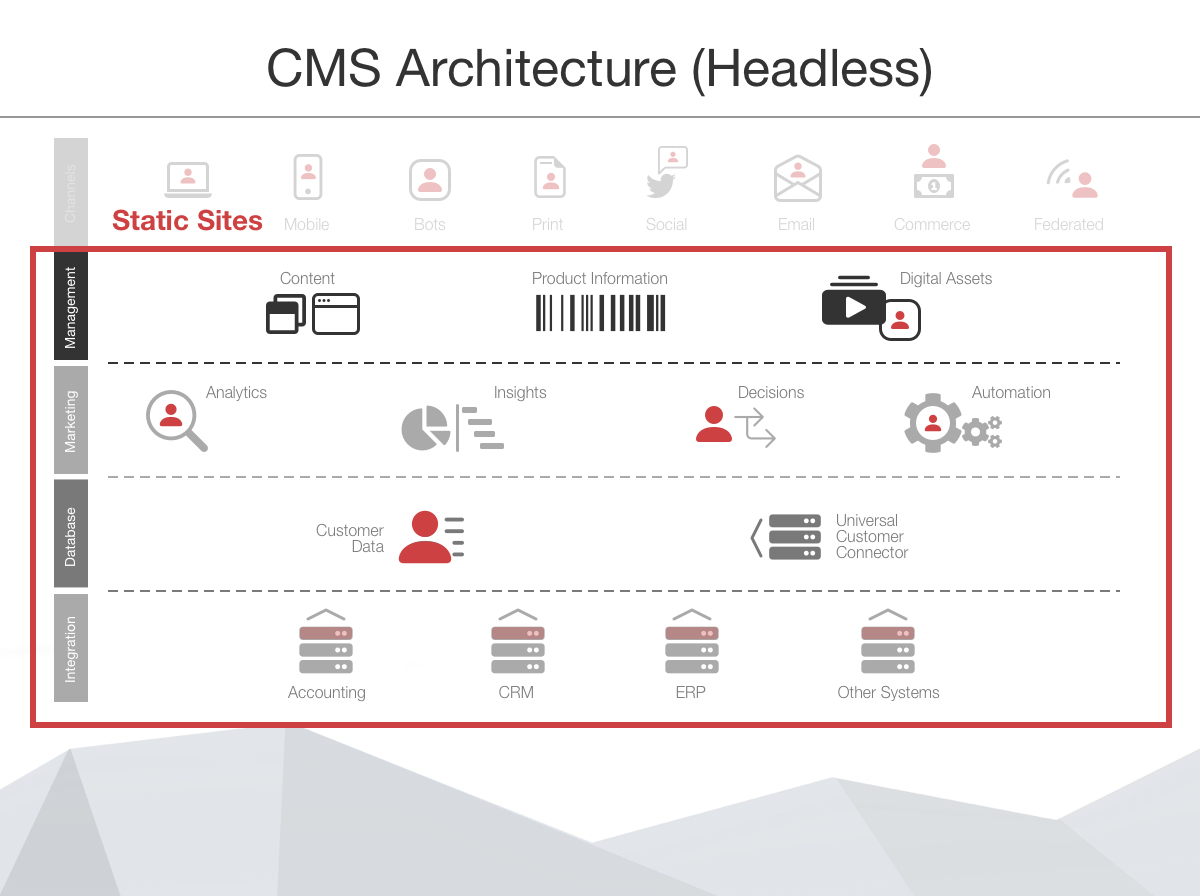
Figure: Headless CMS Architecture
✅ Traditional CMS - Pros
- Simple and fast - For setup and maintenance
- Less reliance on developers - You won't be as reliant on developers to make changes, and may be able to forgo them completely for small-medium projects. More complex CMSs will require developer involvement but non-developers still have some customisation control
- Simple to control look and feel - Using available themes and templates
- Large community support
- Out of the box integrations - Payments, social media, etc
❌ Traditional CMS - Cons
- Performance is not amazing - The frontend is coupled with the backend
- Does not scale very well - All pages render server side, so you will need more servers if you have lots of traffic
- Locked-in - Content is only available on browsers and not on native mobile apps
- Limited flexibility - You are limited to themes and templates, e.g. if you want to build a multi-step form
- You need developers with particular CMS skills - If you have a big website or are using complicated CMS features, you will need CMS developers - e.g. for SiteCore or Sitefinity
- It is not an API first solution
✅ Headless CMS - Pros
- Super fast - Fast initial load time when using Static Site Generator (SSG)
- Scales very well - When using Static Site Generator, and the frontend can be cached via CDN
- Ultimate flexibility with how to use content - Can use a Single Page Application (SPA), Static Site Generator (SSG) or even native mobile apps. Not restricted by themes, templates or vendor, and you can have multiple frontends with 1 headless CMS backend
- Many options to build frontend - NextJs, HUGO. Gatsby, React, Angular, etc. This makes it easier and cheaper to find developers
- Easy publishing - The same content can be published to different platforms at the same time (website, web app, native mobile app)
❌ Headless CMS - Cons
- Very reliant on frontend developers - Anything beyond basic content changes will require frontend dev involvement
- Greater overhead - To maintain the code base, DevOps, etc
- Limited preview functionality - Kontent provides in-context editing via Spotlight, however most Headless CMSs do not. Netlify CMS can help in this case
Hybrid CMS
Some CMSs (e.g. Optimizely offer a hybrid approach including both headless integration and a fully featured UI. As such, you can get the best of both worlds by going down this route. However, pursuing this option comes at a premium with prices matching or exceeding traditional CMSs. An entry level figure for Hybrid CMSs is approximately $50,000 but this figure can quickly increase to several hundred thousand $ as you include add-ons and other features.
Headless CMS Comparison: Kontent vs Contentful
Let's compare two popular CMSs.
Terms:
Content Modelling - The ability to model your website components, and see how they are used in your website Collections - Allows you to manage content dependent on your business and geographical structure. This eliminates the use of silos, which make it more difficult to manage your data
Website optimisation - See the Kontent's useful docs on this topic.
| Name | Kontent (Recommended) - Video (3 mins) | Contentful - Video (1 min) | |||
| In-Context Editing | ✅ Info | ❌ | |||
| Hierarchy | Projects | Environments | Collections | Spaces | Environments |
| Personalized Experiences | ✅ via Uniform | ✅ via Uniform | |||
| SSO and MFA | ✅ | ✅ | |||
| GraphQL Support | Soon: October 2021 | ✅ | |||
| Localization | ✅ | ✅ | |||
| Content Modelling | ✅ | ✅ | |||
| Unlimited Content Types | ✅ | ❌ | |||
| Content Collaboration | ✅ + Simultaneous Editing | ❌ | |||
| Task Management | ✅ Info + better functionality | ✅ Info | |||
| Workflows | ✅ | ✅ | |||
| Website Optimisation | ✅ | ❌ | |||
| Roadmap Transparency | Better: feature release roadmap | Good: Info | |||
| Australian Compliance | ✅ stored in an Australian Azure Data Center | ❌ stored in a United States AWS Data Center | |||
| Dev/Staging/Prod Data Migration | Prod only by default - Add migration script and pipeline | Prod only by default - Add migration script and pipeline | |||
| Email Campaigns | Use 3rd party best of breed tool e.g. MailChimp | Use 3rd party best of breed tool e.g. MailChimp | |||
| User Tracking e.g. Leads, funnels | External CRM e.g. Salesforce Pardot, Dynamics 365 Marketing | External CRM e.g. Salesforce Pardot, Dynamics 365 Marketing | |||
| Statistics | External Analytics e.g. Google Analytics | External Analytics e.g. Google Analytics | |||
| CDN | Fastly | Cloudfront | |||
| Developer Friendly | ✅ | ✅ | |||
| Pricing | Premium: $30,000 pa (cheaper with scaling) | Team: $24,000 pa (with Compose + Launch) |
Assuming you want enterprise features, Kontent is preferred as the Headless CMS of choice over Contentful.
Source: Kentico Kontent vs. Contentful
Dead CMSs
- Microsoft SharePoint for public sites
- CommunityServer.org